
Off-Site Shredding vs Office Storage: Which Carries More Risk Over Time?
Across Australia, businesses accumulate paper records at a steady pace. Tax filings, client contracts, HR records and financial statements pile up in filing cabinets and archive boxes. The question most organisations avoid asking is: how much risk does that pile represent, and does it grow the longer it sits there?
The short answer is yes. Under the Australian Privacy Act 1988 and the Notifiable Data Breaches (NDB) scheme, organisations must protect personal information from unauthorised access or disclosure, including records stored on paper.
The Hidden Risks of Office Document Storage
Many businesses treat their storage room as a low-risk zone because the documents are physically present. Physical proximity does not equal physical security. Several factors make prolonged office storage a compounding risk:
- Unauthorised access: Files stored in open cabinets or shared storerooms are accessible to staff beyond those with a legitimate need, as well as cleaners, contractors and visitors.
- Internal theft: Sensitive records in unlocked drawers or open shelving are an easy target. Human error and employee negligence
- Physical damage: Office environments are not built to protect paper from fire, flooding or water from burst pipes.
- Compliance drift: Without a formal retention policy, documents accumulate past their legally required retention period.
- No audit trail: If a dispute arises over whether a document was accessed or disclosed, office storage offers no record of who handled it or when.
The risk compounds over time. The longer records remain in office storage, the more people cycle through the building and the harder it becomes to identify what is still there or whether it still needs to be kept.
How Off-Site Shredding Compares
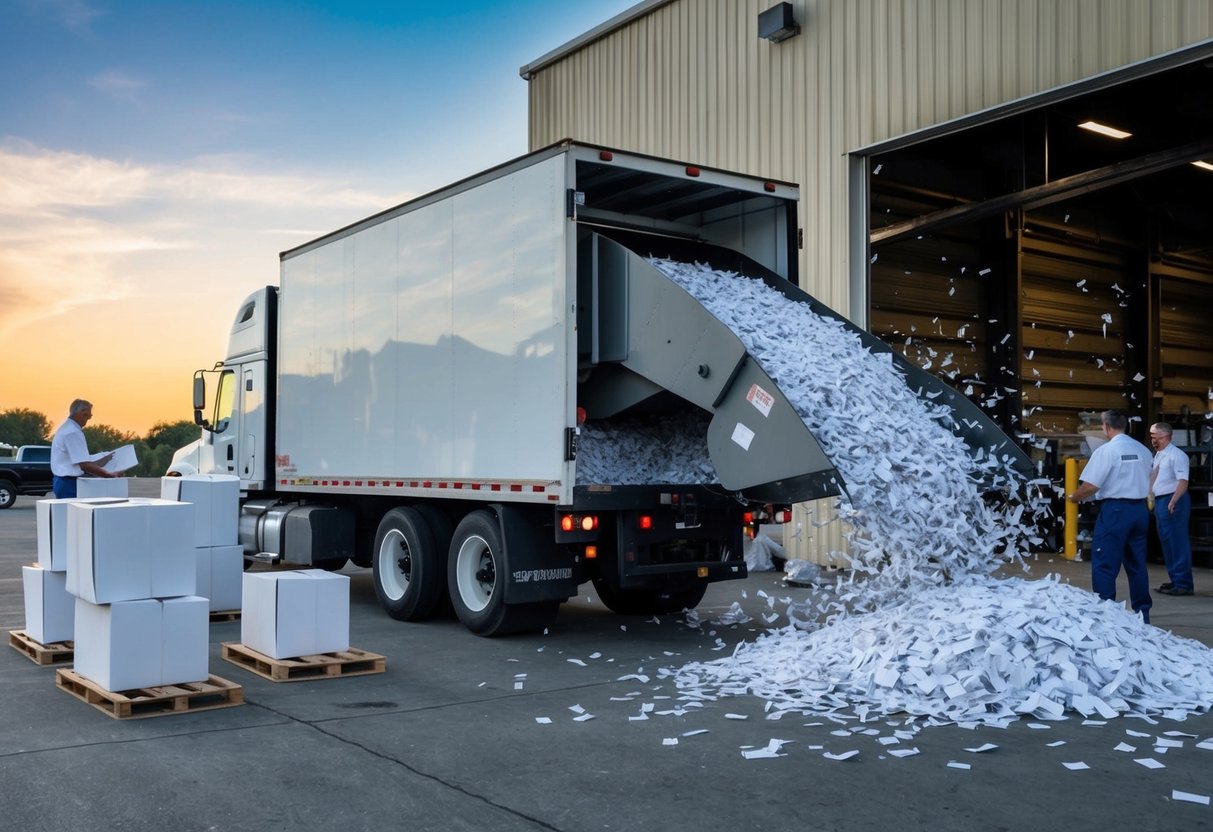
Off-site document shredding removes confidential records from the office entirely. A provider collects filled secure bins or archive boxes, transports them under chain-of-custody controls and destroys the material at a certified facility. The risk profile is markedly different:
- Controlled access: Secure, locked bins are the only point of contact for staff. Documents are not accessible during transit.
- Verified destruction: A Certificate of Destruction is issued after every job, providing a documented audit trail for compliance.
- Regulatory alignment: Professional destruction supports compliance with document retention and disposal obligations
- Predictable cost: Unlike office storage, which quietly consumes floor space and staff time, off-site shredding operates on a transparent per-bin or per-box rate.
Side-by-Side Risk Comparison
| Risk Factor | Office Storage | Off-Site Shredding |
| Unauthorised access | High – multiple staff, cleaners, visitors | Low – chain-of-custody controls |
| Compliance breach | High – documents may exceed retention periods | Low – Certificate of Destruction issued |
| Physical damage (fire, flood) | High – no specialised protection | N/A – documents destroyed before event |
| Internal theft by staff | High – easy access to stored files | Low – secure bins with locking lids |
| Cost over time | Rising – floor space, filing systems | Predictable – flat per-bin or per-box rate |
What Australian Law Requires
Businesses with an annual turnover above $3 million, health service providers and certain government agencies are bound by the Australian Privacy Principles.
APP 11 requires that personal information be protected from misuse, interference and loss. APP 11.2 requires organisations to destroy or de-identify it once it is no longer needed. Failure to comply can result in investigation by the OAIC and significant reputational damage.
Storing records in the office past their retention period is not a neutral position. It is an active compliance risk.
Frequently Asked Questions
1. Is off-site shredding more secure than shredding in the office?
Yes. Office shredders are inconsistent, and strip-cut models do not guarantee documents cannot be reassembled. Professional off-site shredding uses industrial cross-cut or micro-cut equipment at a certified facility with a documented chain of custody from collection to destruction.
2. What records must Australian businesses destroy, and when?
Most financial and tax records must be kept for a minimum of five to seven years under ATO rules. Once that period expires, documents with personal information must be destroyed under APP 11.2.
3. What proof do we get that documents were destroyed?
Reputable off-site shredding providers issue a Certificate of Destruction after every job, confirming the date, volume and method of destruction. This is accepted by regulators and auditors as evidence of compliant disposal.
4. Does office storage breach the Privacy Act?
Not automatically, but it can. If personal information is accessed without authorisation, or records are retained longer than necessary without a compliant disposal plan, a breach of the Australian Privacy Principles may have occurred.
5. Can small businesses use professional shredding services?
Absolutely. Many providers offer one-off collections and scheduled agreements, making off-site shredding practical for businesses of any size. Archive box collections are a popular entry point for businesses clearing accumulated records.
Ready to Reduce Your Risk?
At Hello Shred, we offer Sydney-wide off-site document destruction for businesses and individuals of all sizes. Our secure bins stay on-site while you fill them, background-checked drivers collect on your schedule, and every job ends with a Certificate of Destruction so your compliance records are complete.
From a single archive box clearout to an ongoing 120L or 240L bin service, we make it simple to get confidential records out of your office and destroyed properly. Our fleet is GPS-tracked, our Kingsgrove facility is purpose-built for secure destruction, and shredded material is recycled after every job.
Get an instant quote or book online at helloshred.com.au or call us on 0401 031 275.
Fiverr
